Tuesday, July 5, 2022

Editing a book, just like editing a movie - by Vijaya Schartz


I recently watched a documentary on film editing that got me thinking. The Cutting Edge: The Magic of Movie Editing is a 2004 documentary film directed by filmmaker Wendy Apple. The film is about the art of film editing. Clips are shown from many groundbreaking films with innovative editing styles. It’s available on several streaming services, and you can also find it here: 
https://www.amazon.com/Cutting-Edge-Magic-Movie-Editing/dp/B0009PVZEG


When I watched this documentary, I couldn’t help making comparisons. To me, it was exactly like editing a book. Action and reaction, how to handle dialogue, what to cut and what to keep, what to enhance and what to gloss over, closeup vs. wide lens, seamless transitions, when to speed up and when to slow down, pace and rhythm, focus, and using all these elements together or one by one, to enhance emotions. 


I’m often told my books are fast paced and read like movies, and maybe that’s the reason. I think like a movie editor. I’m very visual, and in my head, when I write I see the scene on a big screen in full action and color. After all, no matter the medium, writers like film makers are first and foremost storytellers. 

From this documentary, I also learned that film editors in the early stages were women and remained anonymous. Later, when it became clear that editing was an important part of the creative process, more men joined the teams. Only recently did film editors get recognized by the movie industry and received well deserved awards. 


Bad editing can ruin a good movie, and brilliant editing can save a mediocre one. So, it also is in book editing. 

That’s why I like to take time to thoroughly rewrite and edit my books like a movie, cutting, pacing, enhancing, and moving paragraphs around, breaking up descriptions and sprinkling them as dialogue tags, removing the fat, then looking for inconsistencies. Editing a book is not just looking for typos or grammar mistakes, although I hunt for them relentlessly. 

After I’ve done my very best and I like the final result, I send my new baby to my publisher… then I pray they like it, and hope my publisher’s editor will catch what I didn’t. 

I’m currently working on ANGEL SHIP, the first book in a new science fiction fantasy series (BLUE PHANTOM) set in the Azura Universe, and scheduled for release in October. 

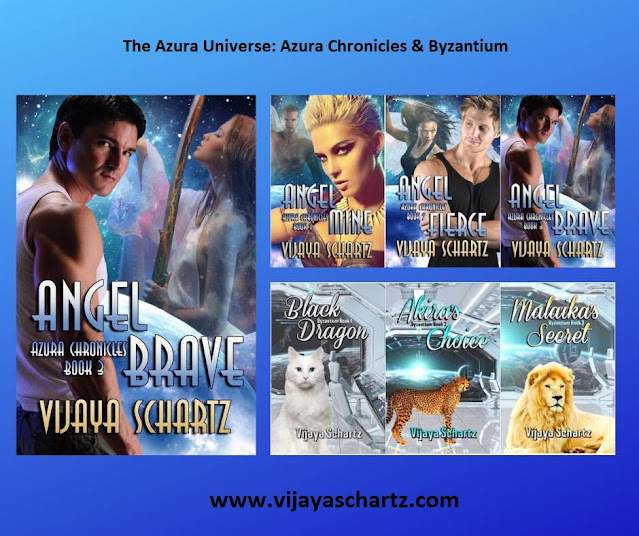
In the meantime, you can read the two other series in the Azura Universe: Byzantium and Azura Chronicles. Available on amazon B&N - Smashwords - Kobo


Vijaya Schartz, author
Strong Heroines, Brave Heroes, cats


Monday, June 6, 2022

Where do science fiction authors find their inspiration? In mythology, of course - Part 2


“Any sufficiently advanced technology is indistinguishable from magic.” Arthur C. Clarke

Last month, we covered the mythology of Asia as a source of inspiration, and Indian mythology that could be interpreted as advanced technology. But this is not unique to that part of the world.


In the Norse legends, Odin possessed two magical raven who flew over the world and showed him everything that happened in real time. These black birds often represented inside a clear globe would now be called “camera drones.” There is mention of a rainbow bridge, which, according to Albert Einstein, could have been a wormhole (or Rosen bridge). Also, Thor, God of Thunder, did have the power to harness lightning and thunder and used them as a weapon.

Similarly, in Greece, Zeus wielded weapons of lightning and thunder capable of great destruction… not unlike our war missiles.

The god Apollo flew north each year in a golden chariot… in other words a shiny metal craft.

The Anunnaki (meaning: they who from the heavens came) claimed to have come to Earth to harvest gold, a commodity they needed to save their own planet. In the process, they genetically improved, educated, and enslaved humans to provide a labor force to work and mine the gold for them. In doing so, they may have started the Sumerian civilization.


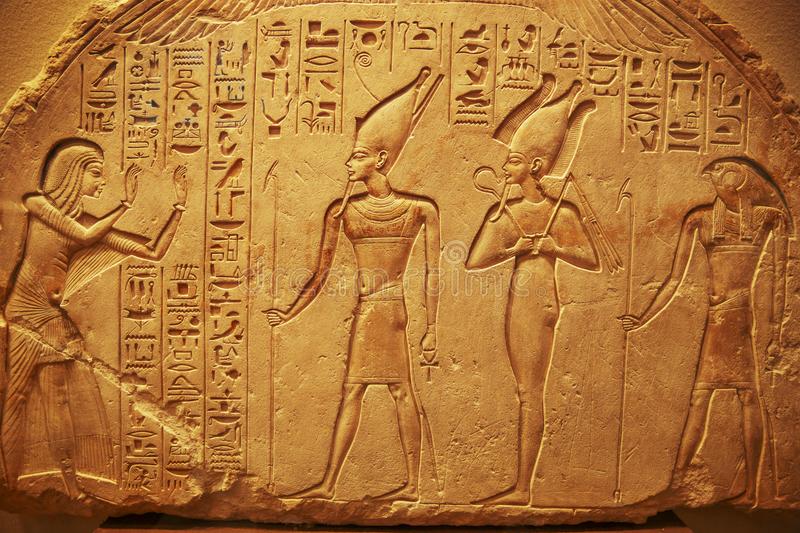
The Egyptian pharaohs claimed to be descended from the gods who came from Orion in barges. They were embalmed to make the trip back. The pyramids are aligned on Orion’s belt.

Ezekiel - St. Augustine Church - Paris France

The Old Testament says Ezekiel saw a chariot coming down to Earth with wheels turning inside wheels… not unlike the modern representations of UFOs.

Jacob witnessed angels climbing a ladder into a luminous craft.


And the Book of Enoch, one of the oldest manuscripts banned from the bible, describes in simple words his trip into space with angels, aboard a spacecraft, where he saw the Earth from space, then went to another planet and studied in their company. The elaborate details of his trip make a lot of sense to a modern mind familiar with space travel, but couldn’t have been fabricated by someone who didn’t understand advanced technology. Yet, this witness account was penned millennia ago.

This happened all over the world. In the Americas, many Native American tribes relate that sky people came as teachers (Kachinas) to educate their ancestors. The Thunderbird can also be interpreted as a vehicle transporting sky people.

The Incas, the Mayas, the Aztec, all had similar stories, about beings coming down in crafts from the Pleiades, sometimes demanding blood sacrifices, and strongly influencing their culture.

Several African tribes also spoke for centuries about being visited by space travelers from the Sirius II system. No one knew Sirius II existed until quite recently, as it is hidden by Sirius I.

So, you see, one doesn’t have to go far to find inspiration about science fiction stories. Space travel and alien visitation are old recurring themes even on our little planet.


This month, Congress reviewed undeniable footage of UAP (Unexplained Aerial Phenomena) taken by the US military, to discuss the implications for National Security.

Soon we will explore space on our own, search for new planets and encounter new civilizations, some more advanced, and others in infancy, and we, too, will become the powerful beings who encourage the pursuit of knowledge and accidentally start new myths and new religions… like in the Star Trek movie, where Captain Kirk inadvertently starts a new cult when the natives witness the Enterprise rising from the depths of the ocean and taking flight.

In the meantime, you can dream and imagine other worlds by reading science fiction, my favorite genre.


Happy Reading!

Vijaya Schartz, author
Strong Heroines, Brave Heroes, cats


Thursday, May 5, 2022

Where do sci-fi authors find inspiration? In ancient mythology - part 1


amazon B&N - Smashwords - Kobo

“Any sufficiently advanced technology is indistinguishable from magic.” Arthur C. Clarke


All science fiction authors struggle to make their stories believable, because most of us only believe what we can explain and understand. Anything else is considered fantasy. And while we witness unexplained feats of magic and fantasy each day, like UAP (Unexplained Aerial Phenomena), ghosts, premonitory dreams, out of body or transcendental experiences, fiction writers are held to more stringent rules. Unlike reality, our stories have to make sense in the physical world.

Readers often tell me I have a fertile imagination, but to imagine the future, you only have to study the so-called mythology of many Earth cultures.


Lord Shiva claimed to be from another planet and traveled through the air on a vessel surrounded by flames

Ancient civilizations worshipped gods who came come from the sky (heavens) in chariots of fire that rumbled like thunder. They were said to possess magical powers, like the power of flight, infinite knowledge, and incredible powers of destruction… powers we now understand as advanced technology.

They lived in magical cities in the sky, cities we would now call motherships, and they flew down in smaller crafts they called Vimanas. They also waged violent wars in the sky, with terrible repercussions for our planet.


Shiva (the destroyer of worlds) wielded weapons that could destroy entire planets and fiery arrows that never missed the target.


The Shiva Lingam found in a multitude of temples, and long discarded as a fertility symbol, was recently recognized as an accurate representation of a nuclear cooling tower. Lingering radioactivity in ancient ruins and bones, along with vitrification of the stone (that only happens with the kind of heat produced by a nuclear explosion), and ancient manuscripts describing epic battles of the gods with such weapons in the same area, support the fact that a nuclear event must have happened around that time… several millennia ago.


In the subcontinent of India, these powerful beings, who visited Earth and lived among men in the faraway past, were not human. They had blue skin, several pairs of arms, sometimes a third eye, monkey heads, elephant head, or snake bodies, and claimed to have come from other planets. To the people of India, they were not mythical or gods, but flesh and blood beings from another place. The epic adventures depicted in the Vedas, the Bhagavad Gita, and the Mahabharata are not considered mythology but true ancient history and taught in schools as such.


But this phenomenon of alien visitors perceived as gods is not particular to India.

In the Buddhist world, the stone stupa inside which the statue of buddha resides represents some kind of transport craft to take him to the “cities in the sky.” Spaceships?


In China, the first emperor descended from the sky on a flaming dragon and claimed to come from space. To this day, the dragon is the symbol of China.


In Japan, Amaterasu, the goddess of light, came down to Earth to start the ruling dynasty to this day.


In my science fiction stories, my characters travel the galaxy, discovering new planets and cultures, or they are planet bound, visited by more advanced aliens.


Vijaya Schartz, author
Strong Heroines, Brave Heroes, cats
http://www.vijayaschartz.com
amazon - B&N - Smashwords - Kobo - FB


Monday, April 4, 2022

How much romance, how much science fiction? by Vijaya Schartz


"...an exceptional tale that belongs in a place of honor on keeper shelves everywhere." Johnna Flores - Coffee Time Romance - 5-cups


Readers of Sci-fi romance expect a good science fiction novel as well as an engaging love story. Some of them also expect love scenes. I sometimes struggle to deliver the latter. As I get older, I tend to focus more on the slow-evolving romance, based on true and lasting feelings rather than lust.


Although many of my novels have love scenes, most of these scenes happen later in the story and are not graphic. Some readers want more of it, while other readers, are perfectly happy with a love story that never makes it to the bedroom, at least on the page.


"RELICS is an intense thrill ride of a futuristic romance; I highly recommend it." - Paranormal Romance - "...an intriguing romance... all the staples of a good science fiction story." Romantic Times - " ...will keep you captivated from beginning to end." 5 hearts Love Romances - "I consider this to be among the best reads of the year!" Fallen Angel Reviews


But let’s face it, I am an action junkie. So, in my novels, you can expect a lot of action and adventure, space adventure, plot twists, evil villains, some paranormal elements, and a clean romance, with a happily ever after ending that will leave you satisfied.


In the sweet sci-fi romance category, you’ll find these titles of mine, also suited for a teen audience.


"I love this one by Vijaya Schartz. As always, her action-packed, well-plotted out prose kept me glued to the pages of Black Dragon from start to finish." TwoLips Reviews 5-kisses review and a RECOMMENDED READ


Vijaya Schartz, author
Strong Heroines, Brave Heroes, cats
http://www.vijayaschartz.com
amazon - B&N - Smashwords - Kobo - FB

Thursday, March 3, 2022

Who is butchering the English language?


Azura Chronicles award-winning scifi-romance series 
The conversation, on some Facebook groups for authors this month, turned to common mistakes in English grammar. As a wordsmith, I cringe at typos, misspellings, and grammar blunders in professional books. And I’m talking about simple mistakes, not wrong tenses, dangling participles, or run-on sentences. In the media arena, the language of Shakespeare is taking a beating. But it’s a lot worse than you would expect.


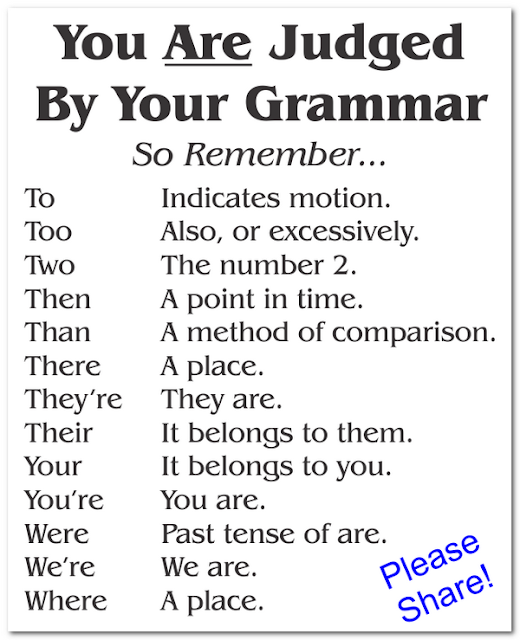
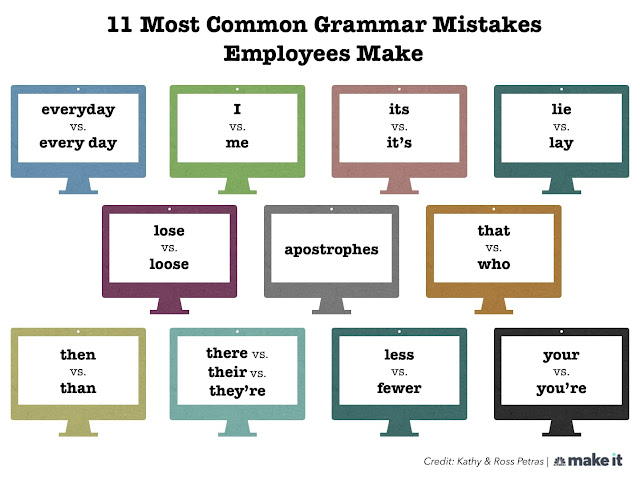
Here is a reminder of a few common mistakes… are you guilty of those? Maybe you should stick this note to the side of your tablet or computer screen.


And these are only a few. There are many more. I particularly resent “it’s” instead of “its” and “than” instead of “then.” There is also “lie” and “lay,” “affect” and “effect,”


I can easily forgive readers and casual posters for not remembering their schooling. But if you make any of these common mistakes on your resume, for instance, you may well have forfeited the job.


And if you run an ad for your business with a mistake in it, the return will be so low, you’ll lose your investment in advertising.


Furthermore, I see these common mistakes repeated by newscasters, on advertising spots, on printed ads, and in articles by news writers and other professional people of the spoken and written word.


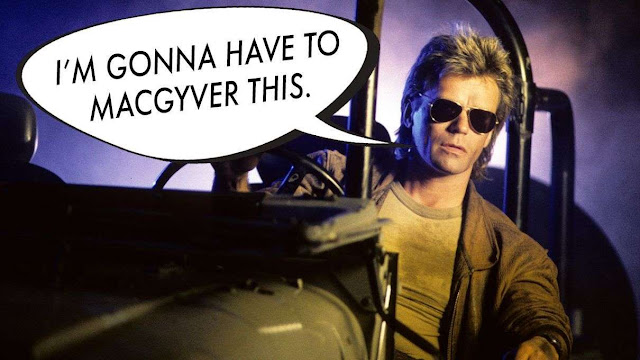
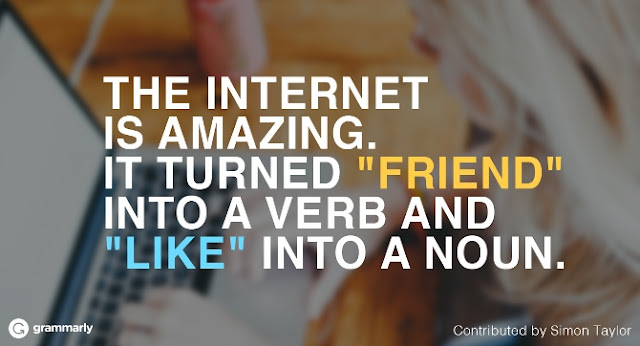
What about “verbing” or “verbification?”

There is also the new tendency of making verbs with nouns, called “verbing” by the Oxford University Press, or also verbification. This is part of normal language evolution. When there is no verb to express the action, you can use a noun as a verb. “To parent,” for example, has become part of the vocabulary, like “to vacation.”


It used to be that the printed word was respected and valued. Nowadays, anyone can write and print anything, without any knowledge of proper language, grammar, or spelling. Worse, they do not hire an editor. If it’s important enough to say or write for the public at large, it’s important enough to be edited.

Another way to improve your grammar is to read well written books. Here are my latest series.

Vijaya Schartz, author
Strong Heroines, Brave Heroes, cats
http://www.vijayaschartz.com
amazon - B&N - Smashwords - Kobo - FB


Monday, February 7, 2022

How soon shall we have to venture into space for survival?

Recently I saw a French documentary on the state of the agriculture in Europe that got me thinking. In it, a chemical expert for the study of soil and crops (in this case wheat) was explaining that all the chemicals we use to grow crops are killing the ground, interrupting the cycle of renewal through natural decay of vegetal and animal origin.

The elimination of weeds and insects has made the soil sterile. The ground is too compact due to lack of animal and vegetal decay, and doesn’t absorb water. If tomorrow the various chemicals used to grow crops were no longer available, the soil is incapable of sustaining any kind of growth, and could be sterile for decades.


Furthermore, the crops themselves, in this case wheat, have been genetically modified (GMO) to adapt to the new farming style. For example, the stems are much shorter and the harvested grain larger. Which is dandy, except that if we stop using chemicals and pesticides, the new species of grain will not be able to survive a natural environment. After all, mother nature made the stems high to protect the growing grain from natural predators, worms, crickets, floods, etc.

As a sci-fi writer, I can see how this could bring instant famine in a post-apocalyptic scenario, with radical weather changes, or even in a pandemic scenario, where the flow of chemicals is interrupted due to crippled manufacturing or interrupted shipping.

But traditional farming failed to produce enough reliable and bountiful harvests, and there are 8 billion mouths to feed in this world. When I was a child, the world population was only 1.5 billion. Think about it… and the numbers keep climbing exponentially.


The problem mankind refuses to face is that there are too many people on this planet and we are killing it to fulfill our needs, whether for food or with plastic waste in the name of practicality. As the population grows, the Earth will eventually die. But killing mother Earth will not help our survival. So, what’s the solution?


If you are familiar with the Avenger movies, Thanos had a simple solution. Instantly kill half the population of every planet. But he was a supervillain, at least in our minds. So, let’s not do that.


China tried restricting the number of children per couple to two, but it only led to selective breeding. They ended up with an overwhelmingly male population and a steep decline. Now, they allow three children per couple.


Of course, as a sci-fi writer, I also have a solution. Let’s colonize Mars and terraform it. Have you seen the movie THE MARTIAN? It is possible. Let’s build and develop autonomous human habitats on the moon and on Mars. Oh, wait, we are already working on that project.


Let’s build space stations the size of a small country and grow artificial crops in orbit, while preserving natural life on this planet.

Let’s explore the universe in search of Earth-like planets to settle. Let’s look toward the stars for our salvation.

Too farfetched? Not at all. Several countries are already developing such programs. China has a very active space program and is already on the moon. Other countries have their own space program as well. 


And with the privatization of space technology, many companies see profit in space mining and are considering space tourism as a profitable venture. Soon, our news will be broadcasting from space, the new frontier, where pioneers will inspire young people to explore new worlds.

amazon B&N - Smashwords - Kobo

All this has already happened in my science fiction novels. But despite scientific advancements, the fundamental needs of mankind remain the same. Food, shelter, friendship, love, recreation, happiness.

amazon B&N - Smashwords - Kobo

Happy Reading!


Vijaya Schartz, author
Strong Heroines, Brave Heroes, cats